Manchester’s Employee Ownership Community Debates the True Meaning of ‘Financial Freedom Day’
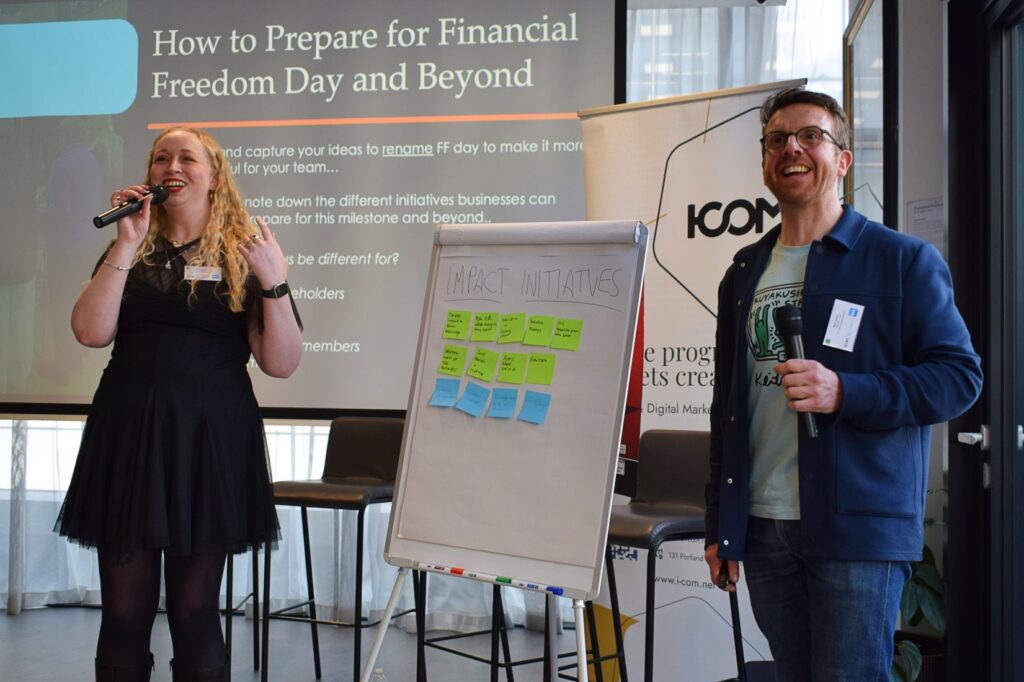
Manchester’s growing employee ownership (EO) community gathered on 11 March 2026 at Neo Bruntwood SciTech for the second Employee Ownership Community Catalyst https://stillwegrow.com/eo-community-catalyst/ event, co-hosted by I-COM (https://www.i-com.net/being-an-employee-owned-business) – Manchester’s first employee-owned digital marketing agency – and EO growth partner, Still We Grow. The event focused on Financial Freedom Day (FFD) and brought together EO advisers and eco-system partners, alongside employee-owned businesses (EOBs), and EO-curious companies.
The event featured a panel of experienced voices drawn from across the EO landscape:
Sarah Baldwin, Managing Director of Kingsland Drinks, an EOB based in the North West, bringing the perspective of a business operating successfully under the EO model.
Dave Wilson, independent trustee, corporate finance adviser, and non-executive director, who currently works with nine EOBs, two of which are operating successfully beyond their FFD milestone.
Jenny Moynihan, who joined Boardmans in 2015 and has progressed to Joint Managing Director, offering an inside perspective on long-term cultural and commercial change within an EOB
What Attendees Are Most Concerned About
During the event, attendees were asked to share their most pressing concerns around the transition to and beyond Financial Freedom Day. The results revealed a community grappling not just with financial mechanics, but with the deeper cultural and structural questions that employee ownership raises:
- 75% Keep EO motivating when cash is constrained
- 0% Succession Planning: Considerations & Risks
- 52% Capital Allocation: Balancing debt & growth
- 48% Reward Frameworks: Leadership incentives
Attendees also cited ‘what to do when the numbers don’t match the plan’ (35%) and ‘the commercial risk of calling it Financial Freedom Day’ (25%) as key concerns.
Should We Rename ‘Financial Freedom Day’?
One of the most thought-provoking themes to emerge from the breakout sessions was a challenge to the language surrounding FFD itself. The term has been lost in translation (https://stillwegrow.com/financial-freedom-day-is-a-misleading-phrase/), and many attendees expressed that the term ‘Financial Freedom Day’ did not fully capture the significance or complexity of the milestone, and suggested that it raises unrealistic expectations.
The group collectively workshopped a range of alternative names, including:
Debt Free Day • Pay Off Day • Voice & Choice • EO New Dawn • Obligation Day • Share Day • Milestone Day • Real EO Day • Gateway Day • Longevity Day • Independence Era • New Beginning
The variety of suggestions reflects the diversity of perspectives within the EO community, and the broader question of how language shapes expectation, culture, and motivation within EOBs.
Voices from the Room
Two attendees from Holden-Smith Solicitors, a firm now one year into their employee ownership journey, were interviewed during the event. Ryanne Smith, Director, and Brittany Clark, Solicitor, both spoke candidly about the realities of transition. Ryanne reflected:
“The day that we went employee-owned, we had lots of staff knocking on the door with ideas, but it was about finding a balance and doing it properly.
“With it being spread out over such a length of time (10 years), it’s not a drastic change. Business day-to-day is very much the same, so it’s about trying to help people to understand the benefits.
But coming to events like this really helps, because we get a lot of ideas to feed back, and we can see what other companies are doing.”
Building a Community That Gives Back
Kate Smith, Director of Client Services at I-COM, commented on the importance of the series:
“Employee ownership has been transformational for I-COM since 2019. We recognised a need for community support as more businesses explore this model. The Employee Ownership Community Catalyst creates a space where leaders and peers can share real stories and insights around their challenges and successes. As members of the EO community, we know how much of a difference it makes to feel connected.”
I-COM’s own track record reinforces the case for the model: more than half of the agency’s team have remained for over seven years, and research demonstrates (https://employeeownership.co.uk/common/Uploaded%20files/eoa%20manifesto.pdf) that employee ownership drives a 73% increase in employee satisfaction and a 20% improvement in performance compared to traditional ownership models.
What’s Next
The Employee Ownership Community Catalyst series will continue to grow, with future events planned to address further stages and considerations in the EO lifecycle. The series is open to all – from businesses at the very start of their EO exploration to those long beyond their Financial Freedom Day.




