Fixed vs. Dome Explosion Proof Cameras — Which One Does Your Site Actually Need?
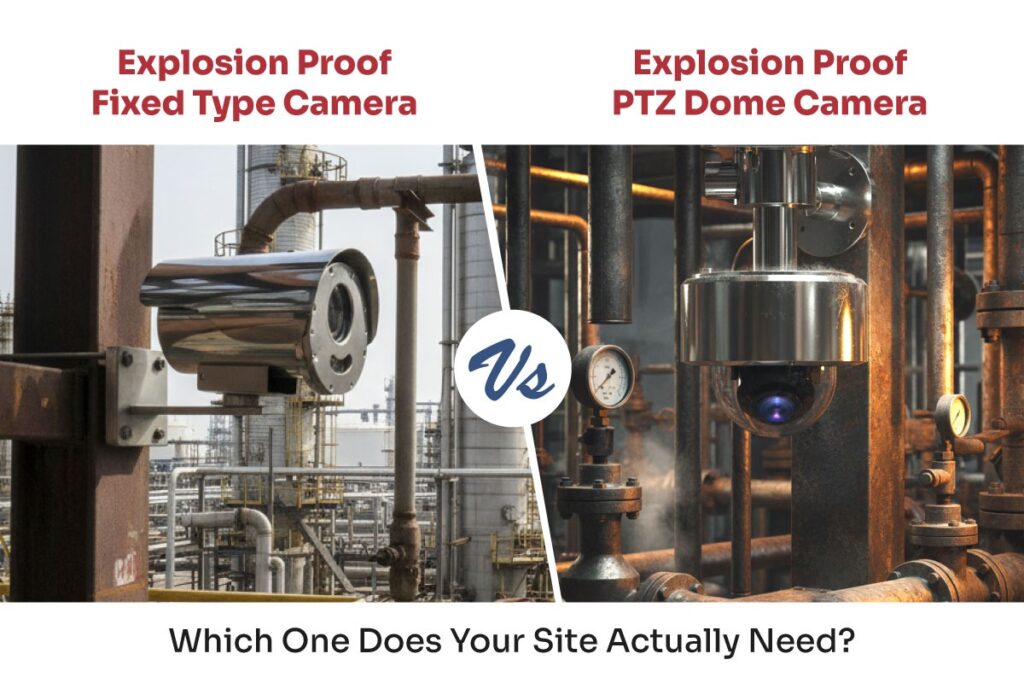
Every safety manager knows the challenge: you have a budget, a hazardous site to monitor, and a catalog of explosion proof cameras to choose from. But which type is right for your specific application?
The two most common form factors in explosion proof surveillance are fixed cameras and dome cameras. Both are ATEX/IECEx certified. Both deliver excellent image quality. But they serve very different purposes — and choosing the wrong one for a critical monitoring point can leave your facility exposed.
This guide breaks down the fundamental differences, the ideal applications for each, and how to make the right call for your site.
Understanding Fixed Explosion Proof Cameras
A fixed explosion proof camera — sometimes called a bullet-type camera due to its elongated housing — captures a single, consistent field of view. It is mounted at a fixed angle and provides continuous, unchanging coverage of a specific area.
This sounds like a limitation, but it is often precisely what hazardous environments require. Consider a custody transfer point on a pipeline, a valve cluster on a manifold, or an entry/exit gate to a restricted zone. These are critical points where you need consistent, uninterrupted documentation of exactly what is happening — all the time, without exception.
Key characteristics of fixed explosion proof cameras: single fixed field of view, typically vandal-resistant and weatherproof to IP66/67/68, longer IR range for outdoor applications (up to 60m or more), motorized varifocal lens for installation-time zoom adjustment, simpler installation with no moving parts to maintain, and full HD or higher resolution in a compact stainless steel body.
Understanding Dome Explosion Proof Cameras
Dome cameras present a fundamentally different profile — literally. Their hemispherical housing provides a lower visual profile and a wide, unobstructed viewing angle. Explosion proof dome cameras can be fixed (covering a wide angle from a static position) or PTZ-enabled (allowing remote pan-tilt-zoom control).
The dome form factor offers unique advantages in certain industrial environments. The rounded housing is more resistant to vandalism and tampering. The dome design also makes it less obvious which direction the camera is pointing — a useful deterrent in facilities where access control is a concern.
Dome cameras are particularly well-suited to indoor environments, process areas with complex layouts, locations where wide-angle coverage is needed without the visual footprint of a bullet camera, and ceiling or overhead mounting positions.
The Critical Decision Framework
When deciding between fixed and dome explosion proof cameras for a specific monitoring point, evaluate the following factors:
- What is the viewing requirement?
If you need to monitor a specific, defined zone — a pump, a valve, a loading point — a fixed camera with an appropriate lens is ideal. If you need wide-area coverage of a room, corridor, or open process area, a dome camera’s wider angle of view provides more efficient coverage.
- What is the mounting position?
Wall-mounted applications on the exterior of buildings or process vessels typically suit fixed cameras. Overhead or ceiling-mounted positions inside control buildings, compressor houses, or enclosed process facilities are natural territory for dome cameras.
- How corrosive is the environment?
Both types are available in stainless steel (SS304 and SS316L) for corrosive environments. However, the dome’s more enclosed housing can accumulate chemical residue more easily than the more exposed fixed camera body — a factor worth considering in highly corrosive atmospheres.
- Is covert monitoring required?
Dome cameras provide a degree of ambiguity about pointing direction. In facilities where this matters — such as security-sensitive areas — the dome’s visual profile can be advantageous.
- What are the maintenance requirements?
Fixed cameras have no moving parts and require minimal maintenance. Dome cameras, especially PTZ variants, have mechanical components that require periodic inspection and servicing. In remote or difficult-to-access locations, the simpler maintenance profile of a fixed camera can be a significant operational advantage.
Combining Both Types for Comprehensive Coverage
In practice, the most effective explosion proof surveillance systems combine both camera types strategically. A well-designed system might use fixed cameras at all critical process monitoring points (compressors, heat exchangers, storage tanks, loading arms), dome cameras in enclosed facilities, control rooms, and at corridor junctions, and PTZ dome cameras at perimeter positions and for wide-area monitoring of large outdoor process areas.
This layered approach ensures that every square meter of your hazardous site is covered appropriately, with the right camera type in the right position.
Common Mistakes to Avoid
- Installing dome cameras where long-range IR is needed: Most dome cameras have shorter IR ranges than their fixed counterparts. Don’t use a dome camera for a 100-meter outdoor run when a fixed camera with 60m+ IR is more appropriate.
- Using fixed cameras for wide indoor spaces: A fixed camera with a narrow lens in the center of a large compressor room will leave significant blind spots. A dome with a wide-angle lens provides far more efficient coverage.
- Ignoring zone classification in camera selection: Ensure the specific camera model is rated for your zone classification — not just ‘explosion proof’ in general.
- Overlooking cable gland certification: An explosion proof camera with a non-certified cable gland can compromise the entire system. Ensure all accessories carry the appropriate certifications.
Conclusion: Right Camera, Right Position, Right Result
Fixed and dome explosion proof cameras are both excellent tools — but only when deployed in the right applications. Understanding the fundamental differences between these form factors, and matching them to your specific monitoring requirements, is the foundation of an effective hazardous area surveillance strategy.
The goal is not simply to install explosion proof cameras. The goal is to eliminate blind spots, deter unsafe behaviour, document compliance, and give your safety team the visual intelligence they need to prevent incidents before they escalate.