From Human Organs to Recycled-Tyre Roads: Oxford and Cardiff Alumnus Dr Aadarsh Mishra Publishes New Research with Springer Nature
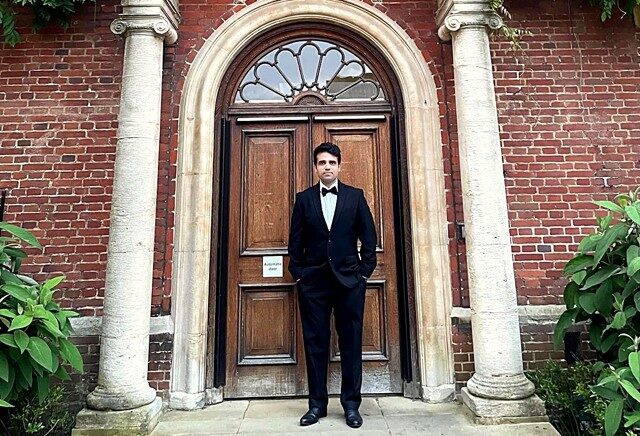
Dr Aadarsh Mishra at the University of Oxford, where he was awarded his DPhil in Engineering Science at the age of 26.
Dr Aadarsh Mishra, who holds a DPhil in Engineering Science from the University of Oxford and a First Class engineering degree from Cardiff University, has taken the mathematical models he developed to study the heart, kidney, liver, brain and aorta and applied them to a very different material: road bitumen made with rubber from recycled end-of-life tyres.
Oxford, UK – Dr Aadarsh Mishra has published a new research paper with Springer Nature in the international journal Mechanics of Time-Dependent Materials. The study shows that the same fractional viscoelastic models he has used to describe soft biological tissues can accurately describe the behaviour of crumb rubber modified bitumen, a more sustainable road binder made with rubber from recycled end-of-life tyres. The work also points to a way of reducing the amount of laboratory testing needed to assess these materials.
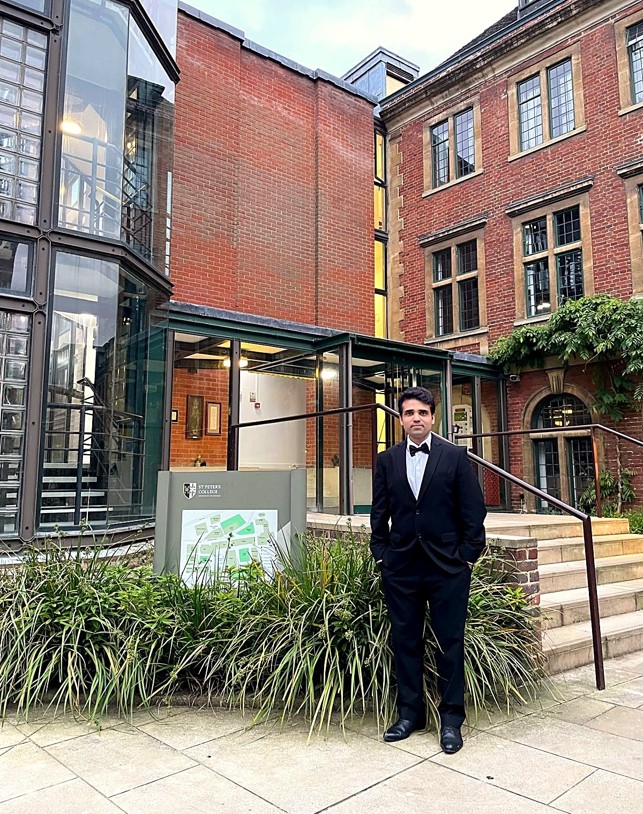 Dr Aadarsh Mishra at St Peter’s College, University of Oxford, where he completed his DPhil in Engineering Science.
One mathematical language, from organs to roads
Over recent years Dr Mishra has built a body of work around a branch of mathematics called fractional calculus. Classical calculus deals with whole-number derivatives, such as the first or second derivative. Fractional calculus extends this to derivatives of non-integer order, such as a “half” derivative. This makes it well suited to describing materials that have a kind of memory, whose response depends not only on what is happening now but on how they have been loaded in the past.
Biological tissues behave this way, and so does bitumen. Both are viscoelastic: partly elastic like a spring, partly viscous like a thick fluid. Dr Mishra has previously applied fractional models to porcine heart, kidney, liver, brain and aortic tissue, and to agarose gels used as tissue mimics, with that research published in journals including Frontiers in Bioengineering and Biotechnology, Bioengineering and Elsevier’s Journal of the Mechanical Behavior of Biomedical Materials. Earlier this year he presented his work on the viscoelastic behaviour of the aorta at the “Aorta: Structure to Rupture 2026” conference in Liverpool.
Why recycled tyre rubber in roads matters
Bitumen is the black, sticky binder that holds asphalt roads together, and its viscoelastic behaviour largely decides how a road copes with traffic, heat and cold. Adding crumb rubber, produced by grinding end-of-life tyres, can improve road performance while giving a useful second life to a waste product that is otherwise difficult to dispose of.
The challenge is that rubber makes bitumen much harder to characterise. When rubber particles are blended into hot bitumen they absorb some of its lighter oils and swell, creating a two-phase material in which bitumen and rubber each respond differently to temperature and loading speed.
Engineers normally assess bitumen using a technique called time–temperature superposition. Tests are run at several temperatures, and the results are shifted and joined together to build a single “master curve” that predicts behaviour over a far wider range of loading speeds than can be tested directly. This only works if the material is “thermorheologically simple”, meaning that a change in temperature speeds up or slows down the material’s internal relaxation without changing its overall character. Rubber-modified bitumen often breaks this assumption, which makes conventional master curves less reliable and increases the amount of testing required.
The physics and the model
To tackle this, Dr Mishra applied a three-parameter fractional Maxwell model. A classical Maxwell model combines a spring (pure elasticity) and a dashpot (pure viscosity). In the fractional version, the dashpot is replaced by a “springpot”, also known as the Scott–Blair element, whose behaviour is set by a fractional order parameter, α:
- α = 0 gives a purely elastic, spring-like response
- α = 1 gives a purely viscous, fluid-like response
- values in between describe the gradual, power-law relaxation seen in real viscoelastic materials
With only three parameters (a limiting stiffness, a characteristic time and the fractional order α), the model captures a broad, continuous spread of relaxation processes that would otherwise need many springs and dashpots, and many more fitting parameters, to represent. The model’s relaxation behaviour is described by the Mittag-Leffler function, a generalisation of the exponential decay found in classical models.
Key findings
- High accuracy with only three parameters. The fractional Maxwell model reproduced the measured stiffness data with R² values above 0.96 and errors below 5% in 50 of the 53 datasets analysed.
- Reliable master curves. Master curves rebuilt from the model closely matched those built experimentally for fresh and short-term aged materials, with R² above 0.989 and errors below about 3%. After long-term ageing the model stayed highly accurate for the 22% rubber blend, while agreement was weaker for the other blends, an honest limitation the paper highlights for future work.
- A new window into material behaviour. The fractional order α rose roughly linearly with temperature, and adding more rubber made α less sensitive to temperature, giving engineers a single, physically meaningful number that tracks how a binder’s relaxation behaviour changes.
- Less laboratory testing. Using α measured only at the coldest and hottest test temperatures (10 °C and 70 °C), the values at 30 °C and 50 °C could be estimated to within 0.06 of the fitted values. This suggests fractional modelling could reduce the number of test temperatures needed, particularly for lower rubber contents.
How the research can be applied
For road engineers and material suppliers, the work offers a compact and physically meaningful way to characterise rubber-modified binders, with the potential to save laboratory time and cost. Better tools for understanding these materials can support wider and more confident use of recycled tyre rubber in roads, helping both road durability and sustainability.
From Lucknow to Cardiff and Oxford
Dr Mishra’s journey began in Lucknow, India, where he studied at St Francis’ College and developed an early fascination with mathematics and science. He went on to graduate with a First Class Honours degree in Mechanical Engineering from Cardiff University at the age of 21.
He then completed a DPhil in Engineering Science at the University of Oxford as a member of St Peter’s College. His doctoral studies were supported by a scholarship from the National Institutes of Health (NIH, USA), which covered his full tuition fees as an international student. His doctoral research focused on passive acoustic mapping for monitoring burst wave lithotripsy, a non-invasive ultrasound therapy for kidney stones, and he was awarded his DPhil at the age of 26.
He subsequently pursued postdoctoral research at the University of Southampton and later worked as a Senior Research Fellow on an aerospace manufacturing research programme, contributing to finite-element modelling and materials characterisation.
His earlier achievements include:
- Co-inventing an “electrode shield” design as an R&D Engineer at Alesi Surgical Ltd in Cardiff, later filed as an international patent application
- Co-authoring a paper in the high-impact journal Nano Letters (American Chemical Society) at the age of 21
- Contributing to a defence-related research project at IIT Delhi, developing experimental set-ups for high strain-rate testing
- Completing a research internship in tribology at the Indian Institute of Science (IISc), Bangalore, at the age of 17
- Publishing a chapter in the book Power Ultrasonics and presenting at international conferences including the Annual European Rheology Conference
His work has been widely recognised. He was elected a Fellow of the Royal Astronomical Society at the age of 19, named a Champion of The British Society for Nanomedicine at 27, and in September 2026 was elected a Fellow of the Royal Asiatic Society.
Inspiration and a vision for the future
Dr Mishra draws inspiration from the Indian mathematician Srinivasa Ramanujan, from former Indian President and scientist Dr A.P.J. Abdul Kalam, and from Swami Vivekananda. He says their example of curiosity, discipline and service shapes his belief that mathematics should ultimately be used to improve people’s lives.
Looking ahead, Dr Mishra intends to bring together artificial intelligence, healthcare and mathematical modelling, a vision behind Biomechanica, the venture he founded to explore how advanced modelling and AI could support better diagnosis and patient care. He hopes his work will continue to build bridges between disciplines, between academia and industry, and between the UK, Wales and Asia.
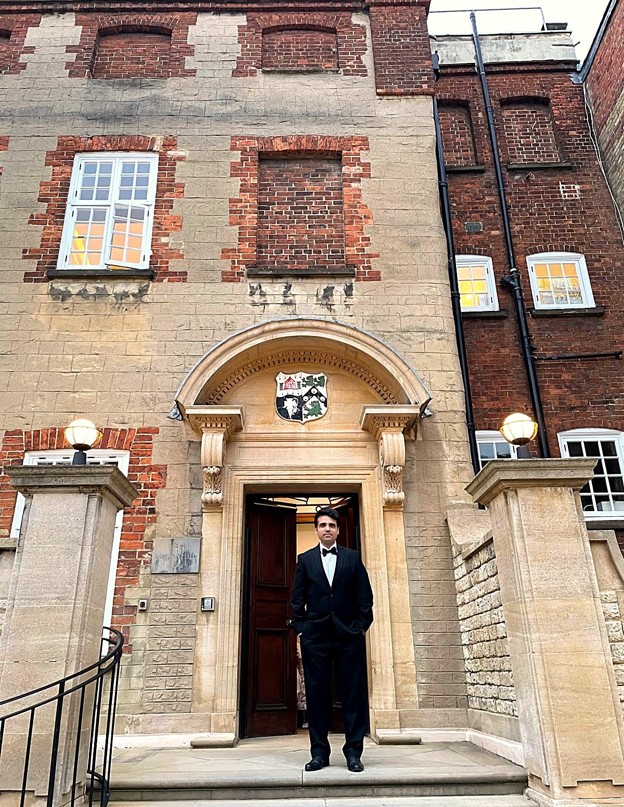 Dr Mishra hopes to bring together AI, healthcare and mathematical modelling in his future work.
“Mathematics allows us to see patterns that are otherwise invisible. Whether the material is a human organ or a road surface, my aim is the same: to use mathematical modelling to make technology safer, more efficient and more useful to society.”
— Dr Aadarsh Mishra